
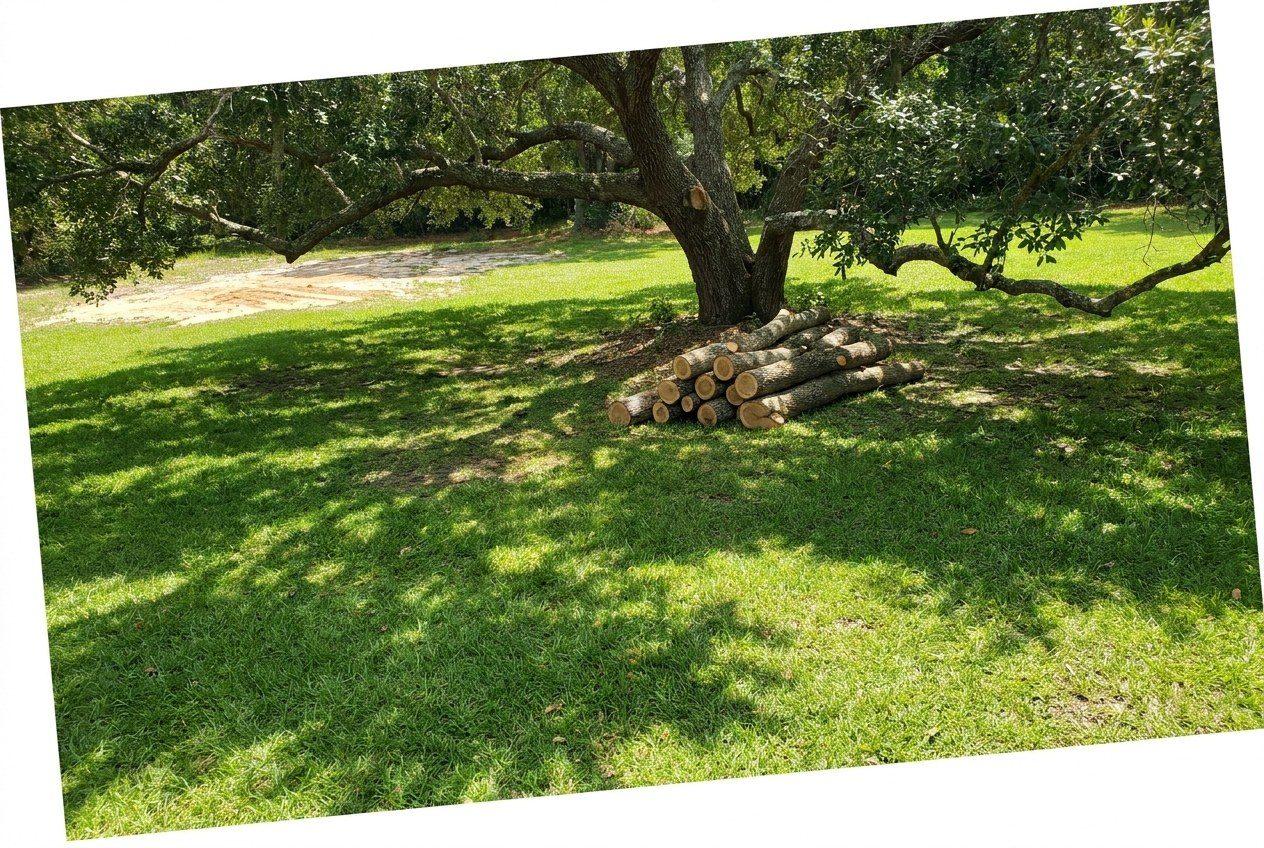
Tree canopy wind load from fall coastal storms is the hidden force behind most storm-related tree failures, and the tree that comes down in your yard while the one next to it stands is almost never a matter of bad luck. It is the shape the tree was already in when the wind arrived.
Fall storm season along the coast is not a single dramatic event. It is a run of systems, each one piling more stress onto trees that may have spent the entire growing season putting on weight in the wrong direction. Right now, before that pattern peaks, is exactly the right moment to look at what your trees are carrying.
#What Does Wind Load Actually Do to a Tree?
Wind load is the force a moving column of air exerts on a structure. For a tree, that structure is the crown, and the crown sits at the top of a long, flexible trunk anchored only by the root plate below ground. When wind pushes against the canopy, the trunk acts as a lever. The root plate is the fulcrum. Physics does the rest.
A symmetrical, well-distributed canopy shares that load across the whole root system. An unbalanced canopy, one that is heavier on one side, taller than it is wide, or carrying a dense cluster of growth at the top, concentrates the lever arm on one side of the root plate. That is where failures begin.
Roots on the tension side of a leaning tree are already working harder than roots on the compression side, even on a calm day. Add saturated soil from a coastal rain event and that imbalance becomes genuinely dangerous.
According to the U.S. Forest Service, wind-related tree failures are most commonly traced to structural defects that were present before the storm, not to extraordinary wind speeds alone. The storm reveals the problem. The problem was already there.
#Why Are Coastal Trees Especially Vulnerable in Fall?
Coastal trees face a specific combination of stressors that inland trees largely avoid. Salt-laden air affects bark and cambium tissue over time, making stems less flexible and more prone to snapping under load. Sandy or loamy coastal soils drain quickly in dry weather but become surprisingly unstable when saturated, reducing the grip the root plate has on the ground below it.
Fall adds another layer. Summer growth is now fully leafed out and at maximum weight. Deciduous trees have not yet dropped their leaves, so they still present a full sail to the wind. And the storm systems that track up the Atlantic coast in September, October, and into November tend to bring prolonged wind rather than brief gusts, which means a tree is not absorbing one sharp load but a sustained one.
- Saturated soil reduces root plate resistance
- Full leaf canopies increase wind resistance surface area
- Sustained coastal storm winds are more damaging than brief gusts of equal speed
- Salt exposure weakens tissue elasticity over growing seasons
A tree that has developed a pronounced lean toward the water, or that has grown a heavy lateral limb over your roof to chase sunlight, is carrying all of these stressors at once. When a storm does bring a tree down, the aftermath often requires more than just cutting, see what storm damage cleanup typically involves in coastal conditions.
#How Can You Spot an Unbalanced Canopy Before Calling Anyone?
You can identify most of the serious warning signs from the ground, without any special equipment. Stand far enough back that you can see the whole tree in one view. Here is what to look for.
A lean of more than fifteen degrees from vertical is worth noting, especially if the lean is toward a structure. One-sided bulk, where the majority of the crown mass is clearly concentrated on one side of the trunk, is another red flag. Look at the major branch unions. If you can see bark folded into a tight V where two stems meet, that is called included bark, and it means the union is mechanically weak. A co-dominant stem, where two trunks of nearly equal diameter fork low on the tree, creates a splitting hazard under load.
Some lean and asymmetry is completely normal in trees that have grown near structures or at the edge of a treeline. A slight lean does not mean the tree is dangerous. The question is whether the imbalance is severe and whether it is pointing toward something that matters.
#What Does Corrective Pruning Actually Fix?
Corrective pruning before storm season is not about making a tree look tidy. It is about changing the physics of how wind force moves through the tree and into the root plate.
The two main approaches used for wind load reduction are crown thinning and crown reduction. They are not the same thing, and they address different problems.
| Approach | What It Does | Best For | Limitation |
|---|---|---|---|
| Crown Thinning | Removes interior branches to let wind pass through rather than push against the canopy | Trees with dense canopies that act as a solid wall in wind | Does not reduce overall height or address a top-heavy center of gravity |
| Crown Reduction | Shortens the overall canopy by cutting back to lateral branches, lowering the center of gravity | Trees that are too tall for their trunk diameter or root plate size | More wood removed; requires careful species-specific technique to avoid decay entry |
For a tree with an unbalanced canopy, the approach is often a combination: reduce weight on the heavy side, remove crossing or rubbing branches that create wound points, and address any co-dominant leaders before they grow large enough that removal itself becomes a structural problem. Professional tree trimming and pruning targets exactly these structural issues ahead of storm season.
What good pruning does not do is top a tree. Topping, cutting the main stem to a stub, removes the tree's natural taper and forces the production of multiple weakly attached shoots from the cut point. Those shoots grow quickly and are poorly attached, creating a worse wind load problem within a few seasons than the one that prompted the cut. The International Society of Arboriculture identifies topping as one of the most harmful practices applied to trees and notes that it almost always leads to long-term structural decline.
#When Is the Right Time to Act Before Storm Season?
Late summer through early fall is the practical window. Trees are still in active tissue response mode, which means pruning wounds begin compartmentalizing before cold weather slows that process. You also want the work done before the first significant storm system of the season, not during or after it.
If you have trees in a coastal area that have not been assessed in three or more years, this fall is not an optional cycle. Canopies that were manageable two growing seasons ago may have put on significant new weight since then, especially after a wet spring and summer.
A tree that fails in a storm costs far more in removal, debris clearing, and potential structural repair than the pruning that might have prevented it. That is not a rhetorical point, it is what the comparison between the two numbers consistently shows.