
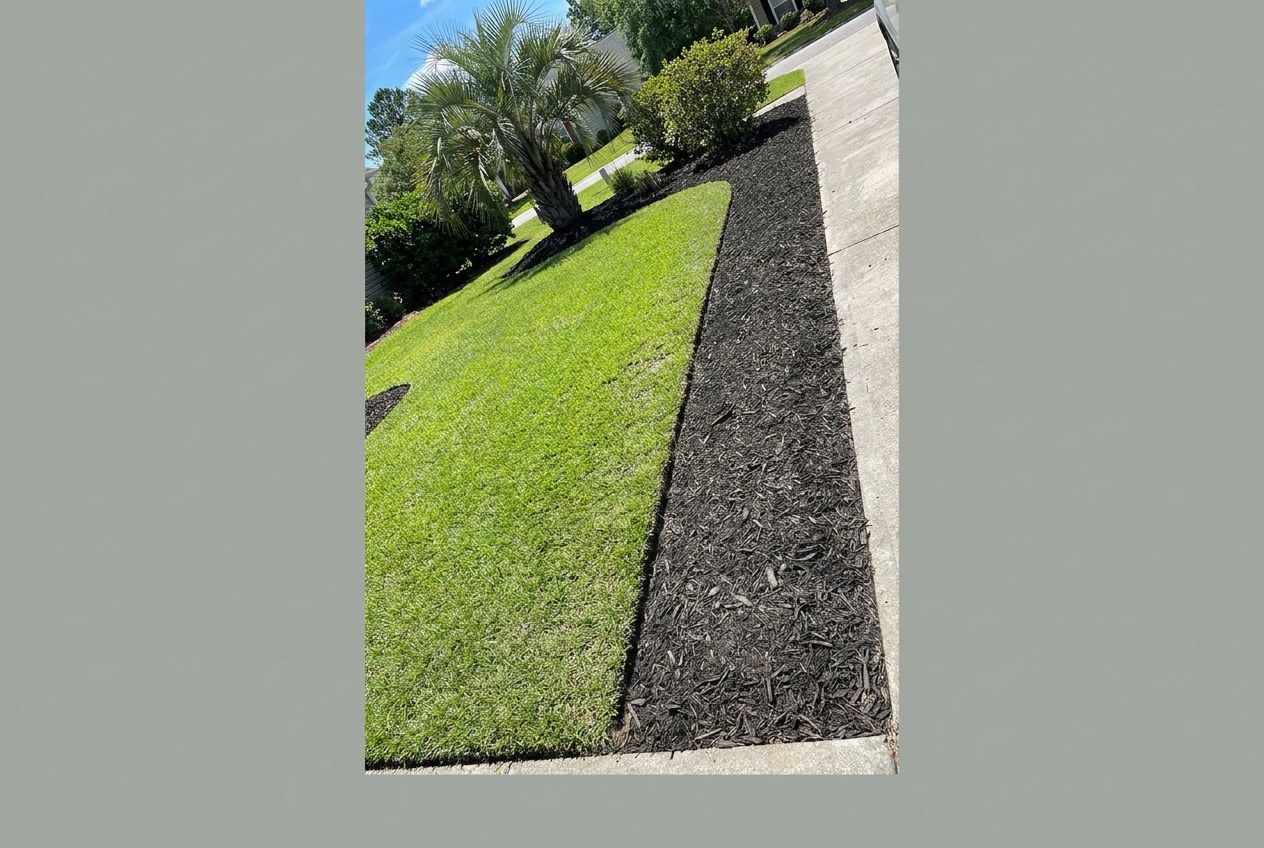
Getting fall mulch depth for shrubs vs. trees right is one of the most consequential things you can do before winter, and one of the most commonly done wrong. You have bags of shredded hardwood or a fresh delivery sitting in the driveway. The shrubs need attention, and so does the oak by the fence. But if you apply the same depth to both, you are almost certainly overdoing it on one of them, and in a wet fall that mistake accelerates rot faster than most people expect.
The difference is not arbitrary. It comes from how trees and shrubs are built at the point where stem meets soil, and understanding that structure takes about two minutes. What you do with that knowledge can keep your plants healthy through winter and set them up for a stronger spring.
#How Do Tree Trunks and Shrub Stems Differ at the Crown?
The crown, in this context, is the zone where the root system transitions into the above-ground stem or trunk. Trees have a distinct flare at that junction, a widening where the main lateral roots spread out just below grade. That flare needs to breathe. It is adapted to being exposed or barely covered, and the bark there is not the same tissue as the bark higher up the trunk. Pack mulch against it and you hold moisture against tissue that has almost no defense against prolonged dampness.
Shrubs are different in one important way: many varieties send up multiple stems from a tight cluster at or near grade, rather than a single flared trunk. Those stems are often closer together, shading the crown naturally. But that cluster is also where moisture collects, and the woody tissue at the base of a shrub stem is just as vulnerable to rot as a tree's root flare, sometimes more so, because there is less airflow between packed stems.
A tree has one trunk with a visible root flare. Many shrubs have multiple stems rising from a dense crown. Both are vulnerable to excess moisture at the base, but the shape of the risk is different, and that changes how you apply mulch around each one.
#What Is the Right Mulch Depth for Shrubs vs. Trees?
For most shrubs, two to three inches of mulch is the practical target. That depth is enough to suppress weeds, moderate soil temperature, and slow moisture loss without creating a wet collar around the stems. Compact shrubs with dense branching at grade, like boxwoods or low-growing hollies, sit at the lower end of that range.
Trees can handle a bit more, three to four inches is a commonly cited range, because the mulch ring around a tree is typically wider and the trunk itself stays clear. The wider the ring, the more the mulch mimics a forest floor, which is genuinely where trees evolved. A mature tree with a proper four-inch mulch ring extending out to the drip line is one of the better low-effort investments you can make in long-term tree health. If overhanging branches complicate your mulching work, our tree trimming and pruning service can open up the canopy before you start.
| Plant Type | Recommended Depth | Crown Clearance | Common Mistake |
|---|---|---|---|
| Shrubs | 2 to 3 inches | 2 to 3 inches from stems | Filling in around the stem cluster, especially on multi-stem varieties |
| Trees | 3 to 4 inches | 6 inches from trunk, never touching the flare | Volcano mulching, piling mulch up the trunk in a cone shape |
The clearance column in that table matters as much as the depth. According to the Arbor Day Foundation, mulch should never touch the trunk of a tree, and the same principle applies to shrub stems. Pull it back. That two or three inch gap at the base lets the crown dry out between rain events, it is not wasted space.
#What Does Too Much Mulch Do During a Wet Fall?
Fall in many regions brings extended rain, slower evaporation, and cooler temperatures that keep soil wet far longer than summer conditions would. That is exactly when excess mulch causes the most damage.
When mulch is piled four or five inches deep against a shrub stem, it acts like a sponge that never fully drains. The stem sits in near-constant contact with damp organic material. Fungal pathogens that cause crown rot and canker diseases are opportunistic, they do not create the wet conditions, but they take full advantage of them. By the time you notice discoloration or a mushy texture at the base of a shrub in late fall or early spring, the damage is often months old.
If you pull back mulch in fall and the soil beneath is staying visibly wet for several days after a rain, the mulch layer is likely too deep or the material has compacted. Break up and thin the layer, or pull it back entirely and start fresh at the correct depth.
The other issue with excessive depth in fall is that thick mulch can prevent the soil from cooling gradually. That sounds like a benefit but it is not, many perennial shrubs need that natural cooling cycle to harden off properly before hard frost. Interrupting it with six inches of insulating material is one reason some plants push late tender growth that gets killed by the first freeze.
#Are There Shrubs That Need Less Mulch Than Others?
Yes. Shrubs that naturally prefer drier soil at the root zone, lavender, rosemary, and most ornamental grasses fall into this category, do best with an inch or less of mulch, or sometimes none at all. Piling mulch around these plants in a wet fall season is a reliable way to lose them over winter.
On the other side, moisture-tolerant shrubs like native viburnums or buttonbush can handle a full three inches without issue, provided the stems stay clear. Knowing your plant's preference is more useful than following a single blanket rule for every bed.
- Drought-tolerant shrubs: aim for one inch or less, or use coarse gravel mulch that drains freely
- Average-moisture shrubs: two to three inches of shredded hardwood or bark mulch
- Moisture-tolerant shrubs: up to three inches, stems always clear
- Trees: three to four inches in a wide ring, trunk completely free of contact
#How Should You Refresh Mulch Around Established Plants in Fall?
Start by pulling the existing mulch back and checking what is underneath. If the old layer is still two inches or deeper and has not heavily compacted, you may only need to fluff and redistribute rather than add new material. Adding on top of a compressed two-inch base often gets you to five or six inches without meaning to.
If you are starting fresh or topping up, lay the new mulch in the ring first and work inward, stopping when you are three inches from any stem or trunk. Do not eyeball the depth, push a finger or pencil in to check. Two inches feels shallower than it looks when you are spreading. Our planting and mulching service handles this process for full beds when the scope is more than you want to take on yourself.
For properties along the coast or in areas with heavy clay soil, drainage is already a slower process than in sandier ground. That makes correct mulch depth even more critical, because water that would drain in 24 hours in loamy soil might sit for two to three days in heavy clay. That variation is worth knowing before you pick a depth and spread it uniformly across every bed.
#Common Questions
Can I use the same mulch for shrubs and trees?
Yes, the material can be the same, shredded hardwood, bark nuggets, or wood chips all work for both, but the depth and placement rules still differ by plant type. The mulch material is less important than how deep you apply it and how far you keep it from the stem or trunk.
Is it too late to mulch in fall once temperatures have dropped?
No, applying mulch after temperatures cool is actually one of the best times to do it, because the goal is to insulate soil against freeze-thaw cycles, not to retain summer warmth. As long as the ground is not frozen solid, mulching in fall protects roots through winter effectively.
What does volcano mulching mean and why is it a problem?
Volcano mulching is the practice of piling mulch in a cone shape up against a tree trunk, often reaching eight or more inches deep at the base. It traps moisture against bark that is not adapted to handle it, encourages fungal rot and pest activity, and over several years can girdle the tree by promoting roots that circle under the mulch layer instead of spreading outward.
How often should mulch be replaced or refreshed around shrubs?
Most mulch breaks down gradually over the course of a year, so a fall refresh and a light spring check covers most situations. The goal is to maintain the target depth, not to strip and replace entirely every season. If you are adding new mulch to an existing bed, always measure what is already there before deciding how much to add.
If you want a second set of eyes on your beds before winter sets in, Coastal Bloom Landscaping LLC is happy to talk through what makes sense for your specific plants and soil.